

By UbongAbasi Ise
Driving round arterial roads in Uyo, the Akwa Ibom State capital, one would luxuriate in the immense beauty and splendour of this southern Nigerian city. The alluring ambience exuded by well-paved roads and scenic roadside landscaping is always instant, but a turn into residential streets may present a sharp ambivalence, typifying a grotesque city of attraction and repulsion.
There are well over 200 untarred, dirt streets and puddled routes within the heart of Uyo metropolis where camera lenses avoid, and even if they are captured, surely, there must be the ‘edit,’ as Governor Amuneke, a persona played by skit maker, Kevin Chinedu Arua, would say, to ensure that it is the deceptive version of the recording that is shown to the public just to score a political point, while the real situation is hidden away from the viewers.
Every dispensation of Akwa Ibom State government comes with a developmental roadmap, but quite unfortunately, internal infrastructures of the state’s capital city are usually allowed to rot, leaving residents to wallow in neglect and abject decay. These neglected areas are highly critical to the life of the city because they are where the majority of Uyo residents take their leave every morning and return in the evening.

A tour of the neighborhood of Godswill Akpabio International Stadium will prove how a community that hosts a sports masterpiece is blatantly left out in the infrastructural development reckoning of the Akwa Ibom State government. It is unbelievable that Synagogue Church Avenue also known as Nsik Street (5.00340, 7.88653 coordinates), including scores of similar routes transecting the neighborhood could remain pristine and left to be overtaken by flood and mud during rainy season, leaving the residents and motorists stranded.


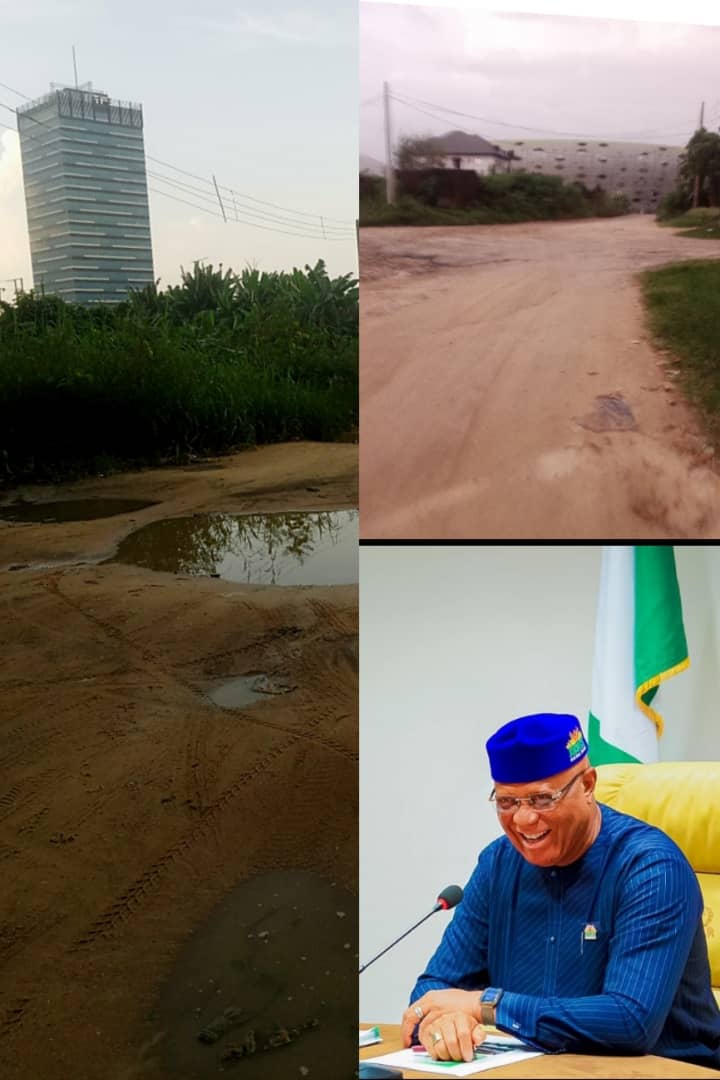
Behind the iconic 21-storey building and the International Worship Centre along Udo Udoma Avenue, there is Afaha Road (4.99274, 7.92964). It is left plain and untarred. However, this dirt street is in an environment that hosts a good number of residents and business outlets. But the area is totally cut off from the sporadic infrastructural development enjoyed by the neighbouring Banking Layout.
Those with a genuine spirit would weep at the sight of Atan Street (5.001800, 7.936700) and its adjoining alleys. It could be hard to navigate this area during the rainy season due to puddles, flooding, and muddy verges. Its entry point is near Oron Road traffic light by Edet Akpan Avenue. From this entrance, Atan Street traverses a vast section of residential area laying between Udo Umana and Nsikak Eduok Avenues. In the same neighborhood, there is Nung Akpa Ime Street and its lookalikes in Itiam Ikot Ebia, near Ibom Tropicana Mall Complex where the Market Square Store is operating. Despite the large-scale development seen in the neighbouring Udo Udoma Avenue, this street is characterized by squalid conditions.


In the neighborhood of the Idongesit Nkanga Secretariat which houses plethora of the ministries, departments, and agencies (MDA) that form the state’s Civil Service, there are a handful of neglected areas edited away from the media spotlight. Prominent among these unpaved routes are Ukana Ebet Lane and Umo Uko Street that are visible from IBB Avenue. These residential access points have been consistently overlooked by successive state administrations despite their proximity to the state secretariat complex where the wheel of government is turned.


It may be unbelievable that certain routes around the iconic Ibom Plaza have never been tarred before. But this is a major landscape that presents a visual identity of the state to the world. Iman Street is still existing unpaved in the 21st century Uyo. There is a residential axis popularly known as No.4 Wellington Bassey behind dilapidated Joesco House, whose residents may not be proud to say that they are living in the centre of Uyo, the Akwa Ibom State capital. The unfortunate condition of this important cul-de-sac, barely a kilometer from the Government House, demonstrates an ebb in the internal infrastructural setup of Uyo, the biggest city in the state.

It could be embarrassing to mention that Orok Close near the highbrow Ewet Housing Estate is part of Uyo. Pothole clusters, and the tiring bare earth surface of the routes meandering through this settlement evince that this community is on the backwater of urbanization and has long been disconnected from the grid of good governance by successive administrations.

A visit to Afaha Ube-Efak Ifia Road near Itam Flyover will prove to you an alarming level of neglect that a critical access road has been enduring following a flimsy attempt at construction. The cratered earthen road, with a clogged drainage system, is just an eyesore and an albatross to the economic life of the residents. On a wet day, pedestrians need stepping stones to walk across muddy and waterlogged portions of the road.

The streets of Uyo discussed here are just a few. They are carefully selected among over 200 neglected dirt routes because they are close to much talked about sceneries in the capital city.
The overemphasis on developing aesthetically pleasing arterial roads and boulevards while neglecting critical internal infrastructure seems not to be an accident, but a deliberate choice and, sometimes, a cynical political interest focusing on a development dimension that is photogenic and highly visible. This is why we have been seeing the ‘edit’ versions of Uyo while the residents and motorists endure internal infrastructural rots.

It is fair to say that this colossal neglect did not start with the administration of Governor Umo Eno. It began with previous dispensations. The past governments might have found other areas of infrastructural development critical at the time. If the construction and rehabilitation of trunk roads were of strategic importance to them, methinks that the remodeling of Akwa Ibom inner cities and towns should be the cardinal agenda of the present state government. A state that received N40,385,478,964.23 in allocation from the federation account in August 2024 alone, not to talk about other months, while realizing over N75 billion in the 2024 sub-national internally generated revenue collections, has a sound income profile and financial capacity to eradicate weak infrastructure in the state’s urban centers.
What makes all tourist havens attractive is the structural organization of their pathways. If Governor Umo Eno is considering tourism as his administration’s policy thrust, then overhauling all of the internal roads system in the urban centres would definitely communicate unedited beauty of the state to the world. If visitors could drive into any of the Akwa Ibom urban centres on ultramodern trunk roads, it will be an exquisite experience for them to stroll round well-paved streets and interlocked pathways that come with breathtaking landscaping. Instead of being stuck in the potholed dirt streets while trying to explore the city, they could navigate round their hotels on asphalted or interlocked streets, savoring well-lit street lights and ornamental trees. This could be an unrivaled legacy for Governor Umo Eno after he leaves office.